Wood movement has gotten complicated with all the engineering talk and moisture content calculations flying around. As someone who has watched boards expand, contract, crack, and warp over decades of building furniture, I learned everything there is to know about why wood moves and how to design around it. Today, I will share it all with you.
Why Wood Moves in the First Place
Wood is a hygroscopic material. That is a fancy way of saying it absorbs and releases moisture from the surrounding air constantly. When humidity goes up, wood absorbs water and expands. When humidity drops, it releases moisture and contracts. This movement happens primarily across the grain — width and thickness change noticeably with the seasons. Along the grain, movement is minimal enough to basically ignore.
I have measured a twelve-inch-wide cherry board change by nearly a quarter inch between summer and winter in my un-climate-controlled shop. That is not a flaw in the wood. It is just what wood does. The sooner you accept this and design for it, the sooner your furniture stops cracking and your tabletops stop pulling themselves apart. That’s what makes understanding wood movement endearing to us serious furniture builders — it is the hidden knowledge that separates lasting work from pieces that self-destruct.
Planning for Movement in Your Designs
Probably should have led with this section, honestly. Every design decision you make should account for the fact that wide panels will get wider and narrower with the seasons.
Tabletop attachment is the classic example. You cannot just screw a solid wood top directly to the aprons through fixed holes. As the top expands and contracts across its width, those fixed screws prevent movement and the top either cups, cracks, or rips the screws right out of the aprons. Use slotted holes, figure-eight fasteners, or shop-made wooden clips that allow the top to slide across the aprons while staying flat. I use wooden buttons that fit into a groove cut in the inside of the aprons. Simple, traditional, and they work perfectly.
Breadboard ends on a tabletop require special joinery to allow the top panel to move while the breadboard stays put. The center tenon gets glued, but the outer tenons sit in elongated mortises with no glue. This lets the panel expand and contract while the breadboard holds it flat. Mess this up and you get a cracked tabletop within the first year. I learned this lesson on one of my early dining tables when a crack opened up right down the middle because I glued the breadboard tenons along the full width.
Seasonal Changes You Should Expect
Wood gets wider in the humid summer months and contracts in the dry winter. In my shop in the northeast, the swing is significant. Drawers that fit perfectly in July stick in August and rattle loosely in January. This is normal. Experienced woodworkers leave tiny clearances in their drawer builds to account for this.
Applying a finish slows moisture exchange but does not prevent it. Even a full film finish like polyurethane only delays the inevitable. The wood underneath is still moving, just at a slower rate. Climate-controlled environments reduce the extremes, which is why museum-quality furniture lives in climate-controlled spaces.
Design Solutions That Work
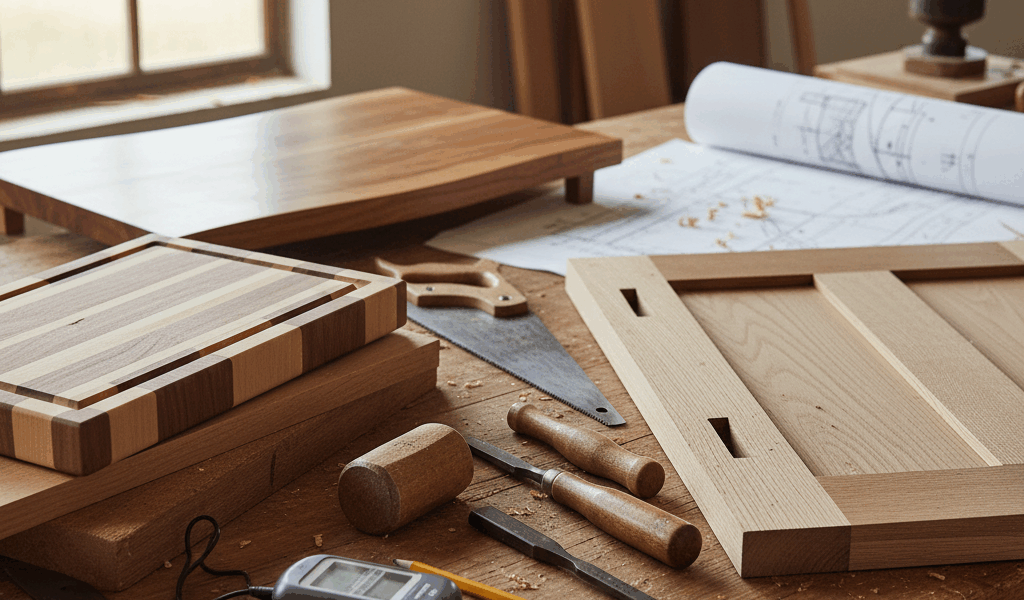
Frame-and-panel construction is the classic solution that has worked for centuries. The panel floats in grooves cut into the frame, free to expand and contract without affecting the overall dimensions of the assembly. Doors, cabinet sides, and chest panels have used this approach since the Middle Ages because it works. I use frame-and-panel construction on every cabinet door I build.
Floating panels in grooves is the standard method. The panel is not glued into the groove. It sits there with space to move. Sometimes I put a small dab of glue at the center top of the panel to keep it centered in the frame, but the sides and bottom float free.
Elongated screw holes allow fasteners to slide as wood moves. I drill oval holes in cleats and stretchers wherever I am attaching a solid wood panel to a frame. The screw head slides along the slot as the panel changes width. Easy to do and completely effective.
Cross-grain construction — gluing two boards with their grain running perpendicular to each other — fights against wood movement and eventually fails. The two pieces want to move in different directions and something has to give. This is why cutting boards with end-grain borders crack, and why you should never glue a solid wood edging across the grain of a plywood panel unless the edging is very narrow. Design with the grain, not against it.


Stay in the loop
Get the latest classic custom wood furniture updates delivered to your inbox.