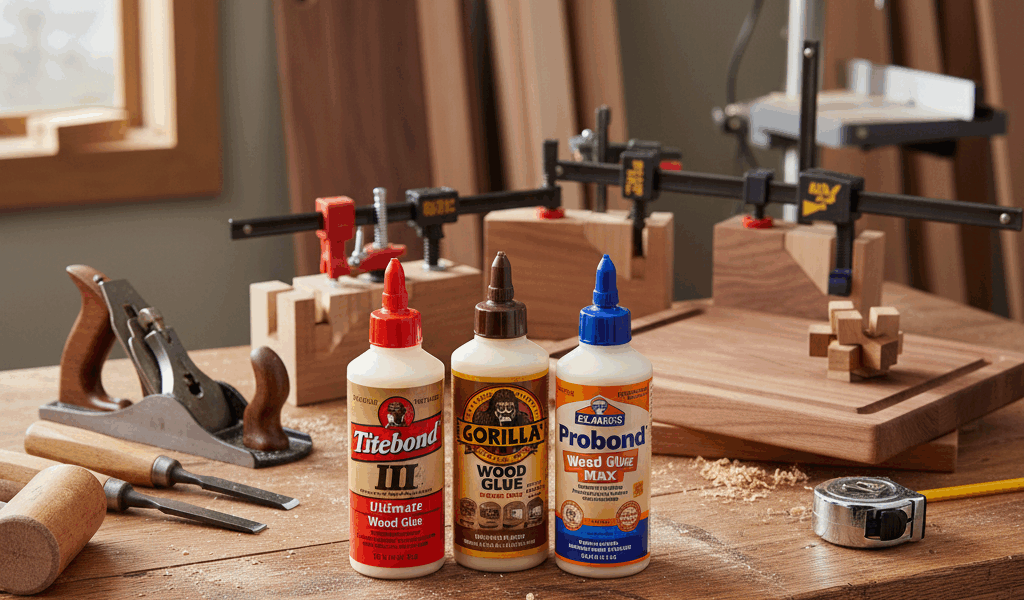
Wood glue selection has gotten complicated with all the specialty formulations and marketing claims flying around. As someone who has glued up more panels, joints, and assemblies than I can count over the years, I learned everything there is to know about Titebond, Gorilla, and Elmer’s — the three big names on the shelf. Today, I will share it all with you.
Titebond — The Professional Standard
This is what most professional woodworkers use, and for good reason. The Titebond lineup gives you options for every situation.
Titebond Original is my go-to for eighty percent of projects. Indoor furniture, cabinets, general shop work — Original handles it all. It is not water resistant, but that does not matter for things that live inside. The bond is incredibly strong, it sands without gumming up, and cleanup with a damp rag is effortless. At the price point, you cannot beat it for everyday work.
Titebond II is Original with water resistance added. I use it for cutting boards, pieces that will live in humid environments like bathrooms, and outdoor furniture that stays under a covered porch. Basically anywhere moisture might be present but the piece is not submerged. Think of it as Original with insurance.
Titebond III is the full waterproof option with extended open time and FDA approval for indirect food contact. More expensive than the other two, but necessary for outdoor projects exposed to rain and marine applications. The longer open time is actually my favorite feature — it gives you an extra few minutes on complex glue-ups where you need to align a lot of pieces before the glue grabs.
Gorilla Wood Glue
Probably should have led with this section, honestly, because this is where the confusion usually starts. Gorilla makes a PVA wood glue that competes directly with Titebond II. This is not the foaming polyurethane Gorilla Glue that expands everywhere and makes a mess. Different product entirely.
The Gorilla PVA has a slightly thicker consistency than Titebond. Some woodworkers prefer this for vertical applications because it does not run as much. Others find it harder to spread evenly on large panel glue-ups. Water resistant. Longer open time at about ten minutes, which helps on complex assemblies.
Strength is basically identical to Titebond when you clamp properly. I have seen people argue online about which is stronger for years. In real-world use, both create bonds that are stronger than the wood itself. Pick whichever you prefer working with — you will not go wrong either way.
Elmer’s Carpenter’s Glue
Cheaper than the other two. Fine for light-duty stuff and craft projects where ultimate strength is not critical. Their Max version adds water resistance and works well enough for hobbyist work and general woodworking.
I will not use Elmer’s on furniture I am building for clients, but for shop jigs, fixtures, and things that just need to hold together without looking pretty? It works fine and costs less. I keep a bottle in the shop for exactly those situations.
What Actually Matters More Than Brand
Here is the secret that the glue manufacturers do not want you to think about too hard: technique matters more than which brand you pick. A properly clamped joint with Elmer’s is stronger than a sloppy Titebond III joint every single time. That’s what makes good gluing technique endearing to us woodworkers — it saves money and produces better results than just throwing expensive products at the problem.
Clamping pressure is essential. Thirty minutes minimum for handling strength, twenty-four hours for full cure. Do not rush it. I label my clamp-ups with the time so I am not tempted to pull clamps early.
Temperature matters. Stay above fifty degrees Fahrenheit or the glue will not set properly. My shop gets cold in winter, and I have learned to either heat the space or wait for warmer days for critical glue-ups.
Joint fit is critical. PVA glue is terrible at filling gaps. If your joint has daylight showing through it, fix the joint — plane it, sand it, recut it. Adding more glue to a bad joint does not make it stronger. It makes it weaker because thick glue lines are actually less strong than thin ones.
My Honest Recommendations
Keep Titebond Original around for most work. It is affordable, reliable, and available everywhere. Get Titebond III for anything outdoor or food-contact related. Use Elmer’s or cheap PVA for shop jigs and test pieces where premium glue is wasted money.
Do not overthink it. They all work when you clamp them properly and let them cure fully. The best glue is the one you have on the shelf when you need it.

Stay in the loop
Get the latest classic custom wood furniture updates delivered to your inbox.