Plywood vs Solid Wood for Cabinets — Which Is Better
Plywood vs solid wood for cabinets has gotten complicated with all the conflicting advice flying around. As someone who spent twelve years building cabinets — starting as a side hustle out of a two-car garage before it became my actual livelihood — I learned everything there is to know about both materials. Today, I will share it all with you. And unlike most articles on this topic, I’m not ending with “it depends on your situation” and leaving you exactly where you started.
The Core Difference Between Plywood and Solid Wood
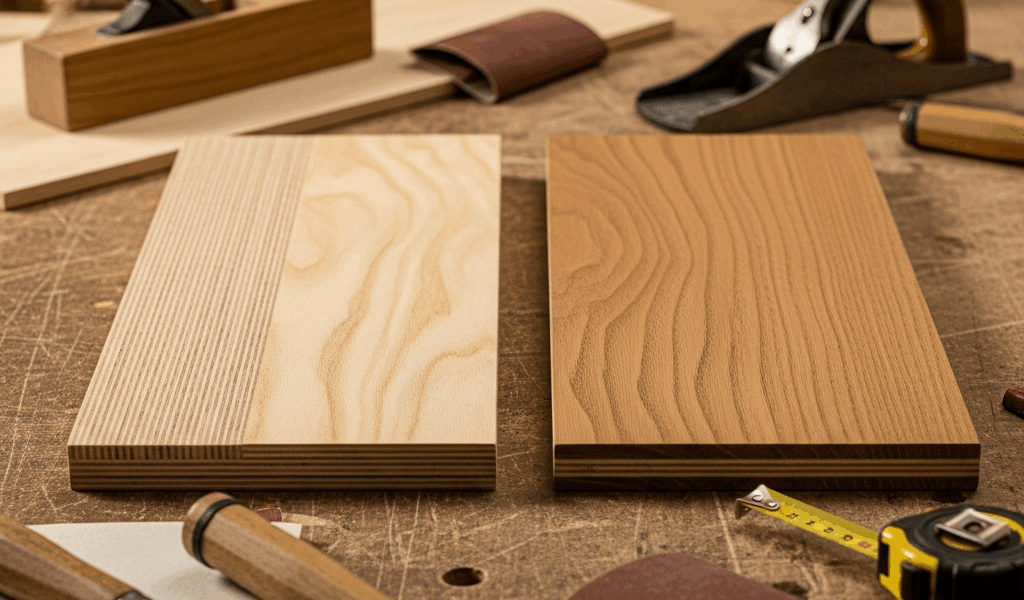
But what is plywood, really? In essence, it’s thin wood veneers glued together in alternating grain directions — typically 3, 5, or 7 layers depending on thickness. But it’s much more than that. That cross-grain construction is the whole point. Each layer wants to move in one direction. The layer above it refuses. The result is a panel that stays remarkably flat even when humidity swings hard in both directions.
Solid wood is milled from a single piece of lumber. Strong, beautiful, and — here’s the part nobody mentions upfront — it moves. A 12-inch wide solid oak board can shift nearly a quarter inch across its width between a dry February and a humid August. That’s not a defect. That’s just wood being wood. Cabinets don’t move with it unless they’re specifically designed to allow it, which most aren’t.
Kitchen environments are brutal, honestly. Steam from pots, dishwasher exhaust cycling through the cabinet below, oven heat radiating outward — all of it hits constantly. Dimensional stability isn’t a luxury in that environment. It’s a requirement, at least if you want the box work to hold together past year three.
Strength and Durability Over Time
Plywood holds screws well throughout the panel — especially at the face, less so at the raw edge where the plies are exposed. Drive a screw into the edge of 3/4-inch plywood and you’ve got decent holding power. Drive it into the face and you’ve got excellent holding power. Compare that to MDF, which strips out at edges almost immediately, and plywood looks like a champion.
Solid wood holds screws extremely well in most orientations. It can also be routed, carved, and profiled in ways plywood simply can’t match. A raised panel door with a cove profile on the edge requires solid wood. There’s no plywood version of that which looks right. None.
Don’t make my mistake. I built a set of bathroom vanity boxes out of 3/4-inch poplar early on — glued and pocket-screwed the whole thing, very proud of myself — and within two years the back panel had pulled away from the side on one unit. The wood had moved, the glue joint couldn’t keep up, and I had a gap you could slide a credit card through. Plywood boxes don’t do that. I’m apparently someone who needed to ruin a $600 vanity build to learn that lesson, and solid wood boxes never worked for me the same way after.
Cost Difference and Where It Actually Shows Up
Probably should have opened with this section, honestly, because budget is the first filter for most people — not an afterthought.
A sheet of cabinet-grade maple plywood — something like Columbia Forest Products PureBond in 3/4-inch — runs around $65 to $85 depending on your supplier and region. Baltic birch, which is a different animal entirely with more plies and a cleaner core, runs $90 to $120 for a 5×5 sheet. Solid poplar, the budget choice for painted work, might cost $3.50 to $5.00 per board foot. Hard maple for stained work hits $8.00 to $12.00 per board foot without blinking.
Raw material price isn’t the whole picture, though. Solid wood requires milling — jointing, planing, gluing up panels when you need width. Waste adds up fast. A 10-foot board with a knot dead center costs you that section entirely. Plywood sheets yield predictably. You can sheet out an entire base cabinet box from two sheets with careful layout and almost no scrap.
Labor is where solid wood really compounds. Gluing up a solid panel for a cabinet side takes real time — time plywood doesn’t require. Across a whole kitchen build, that gap adds up to something significant on the invoice.
How Each One Takes Paint, Stain, and Finish
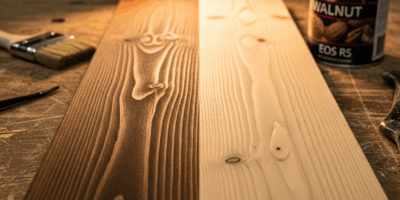
Frustrated by a finish that looked nothing like the approved sample, I once spent an entire afternoon trying to stain plywood face grain to match a solid walnut door. It never matched. The veneer face on plywood — even good cabinet-grade material — absorbs stain differently than solid wood. Flat, almost muddy. The grain shows up, but the depth doesn’t follow.
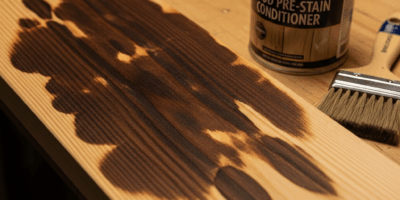
Solid wood takes stain beautifully when grain is oriented correctly. End grain drinks it and goes dark fast. Face grain on a quartersawn board looks rich and consistent. Get a door with mixed grain directions — which happens when you’re not careful about glue-up orientation — and the stain comes out uneven in ways that are genuinely hard to fix after the fact.
Paint is a completely different situation. Plywood takes paint better than most people expect, especially with a good primer and a light sand between coats. The face veneer on cabinet-grade plywood is smooth enough that paint levels out well. Edges need either iron-on edge banding or a skim of wood filler before painting — that’s non-negotiable — but once they’re handled, painted plywood boxes look completely clean.
For painted work, solid wood is actually harder in some ways. Poplar can have green streaks that bleed through paint without a shellac-based primer, like Zinsser BIN. Pine moves enough that painted joints sometimes show a hairline crack over time. That’s what makes plywood endearing to us painters — it just doesn’t do any of that.
Which One to Use and When
Here’s the actual answer — the one most articles skip past entirely.
Use plywood for cabinet boxes. Always. The stability, the yield, the screw-holding, the way it handles kitchen humidity — it wins that category without much contest. 3/4-inch plywood for sides, tops, and bottoms. 1/2-inch for backs inset into a dado, or 3/4-inch if the back is doing structural work.
Use solid wood for doors and face frames. Standard practice in professional cabinet shops for a reason. Doors need routing and profiling. Face frames get touched constantly — fingers grabbing, doors bumping into them. Solid wood handles that contact better over the long run. So, without further ado, here’s the breakdown:
- Cabinet boxes — plywood, no exceptions for serious work
- Face frames — solid wood, typically 3/4-inch poplar for painted work, hard maple or cherry for stained
- Doors — solid wood frames with either solid wood or plywood panels depending on size
- Drawer boxes — plywood, or Baltic birch specifically if you want them lasting decades
- Shelves — plywood for any span over 24 inches; solid wood sags more under load
For budget builds where everything gets painted, you can stretch plywood further — even into face frames — and save real money. Nobody will know once it’s primed. For stained natural finishes, spend the money on solid wood where it’s visible and keep plywood everywhere it isn’t.
That’s the honest answer. Not complicated. Just rarely stated plainly.


Stay in the loop
Get the latest classic custom wood furniture updates delivered to your inbox.