Maple vs Oak for Furniture — Which Wood Is Better?
Maple vs oak is surrounded by more bad advice than good at this point. Everyone’s got an opinion. As someone who’s been building furniture for going on nineteen years, I figured out most of what you need to know.
People walk into my shop, run their hands along a sample board, and want a straight answer. Hard maple or white oak for the dining table? Red oak or maple for the bedroom set? I can usually sort it out in about ten minutes of conversation. But the short version: neither wood is universally better. The right one depends entirely on your project — and I’ll show you exactly how to figure that out.
Hardness and Durability
Start with the numbers. Hard maple sits at 1450 on the Janka hardness scale. White oak lands at 1360. Red oak trails at 1290. Pine — the stuff holding together that flat-pack dresser you assembled at midnight — hovers somewhere between 400 and 600 depending on species. All three hardwoods are genuinely tough by comparison.
The Janka test embeds a steel ball halfway into a wood sample and measures the force required. Real test, real implications. A dining surface rated 1450 shrugs off a dropped fork the way a 1290 surface won’t — not dramatically, but over fifteen or twenty years of daily meals, those small differences stack up in visible ways.
Hard maple is one of the hardest domestic hardwoods available in North America. Bowling alley lanes. Butcher blocks. NBA courts. When a client tells me their kitchen prep table is actually going to get used hard — daily cooking, serious chopping — hard maple is my first call. Nothing in the domestic hardwood category resists denting and scratching quite like it.
White oak has something maple simply doesn’t. Tyloses — microscopic structures that plug the wood’s pores, making it naturally resistant to water and rot. That’s why white oak built ships for centuries. It’s still the only wood used for wine and whiskey barrels. For outdoor furniture, mudroom benches, or farmhouse tables in kitchens that steam up regularly, white oak wins that durability conversation outright. No contest.
Red oak, by comparison, has open pores and zero tyloses. It absorbs moisture readily. I still use it — plenty — but I’m more aggressive about sealing it, and I steer clients away from red oak for anything living near a sink or in a genuinely humid room. Take it from me: I built a small console table in red oak for a client’s laundry room early in my career. Two years later, the thing had warped noticeably. Expensive lesson.
Grain Pattern and Appearance
This part deserves more attention than it usually gets. Most people buying furniture care far more about how a piece looks than how it performs on a hardness test they’ve never heard of before walking into my shop.
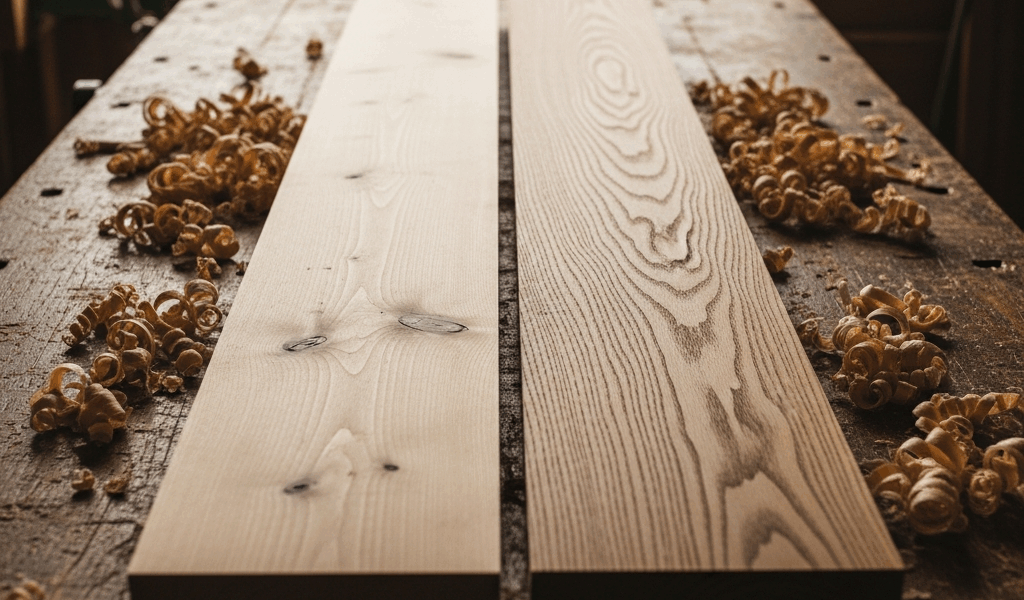
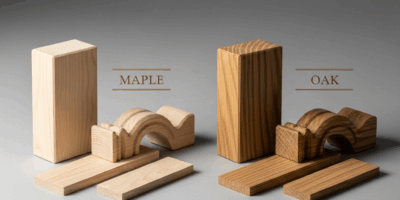
Oak has presence. Bold, open, pronounced grain — visible from across the room. Quarter-sawn white oak, where the log is cut at a specific angle to the growth rings, produces those dramatic ray fleck patterns that are having a serious moment in furniture design right now. I’ve had more requests for quarter-sawn white oak dining tables in the last three years than in the full decade before that combined. Designers love it. Clients who see it in person almost always want it immediately.
Red oak shares that open grain but without the flecks and without quite the same visual drama. Warmer tone — reddish-pink, almost. Some people genuinely love that warmth. Others find it dated — it was everywhere in American furniture from roughly 1985 to 2005, so it carries generational associations depending on who’s standing in front of it.
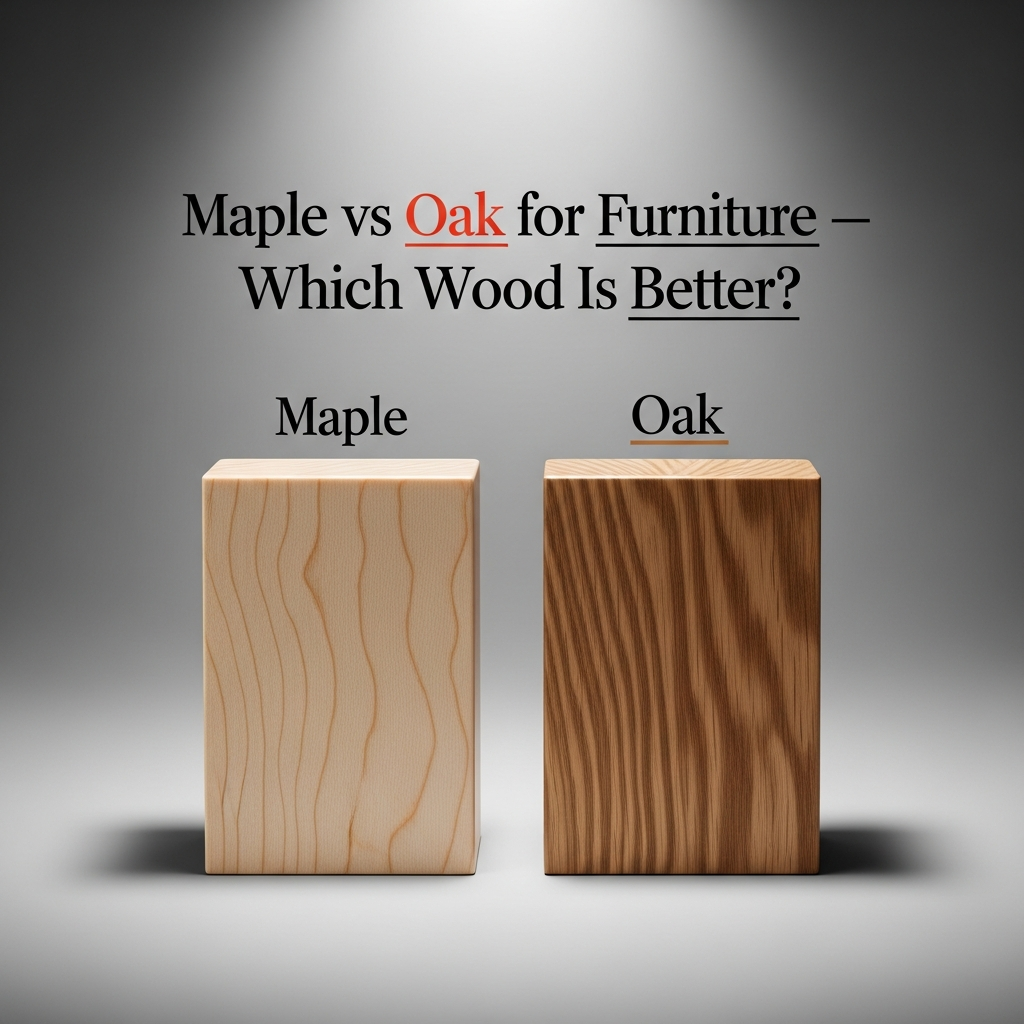
Maple is a completely different experience. Tight, fine, subtle grain. Plain-sawn hard maple can look almost creamy and uniform — close to featureless if you’re hunting for drama, beautifully calm if you’re not. Then occasionally you find figured maple: curly maple with its wavy chatoyance, bird’s eye maple with those small scattered circular patterns. Figured maple is genuinely stunning — and priced accordingly. I paid $18 per board foot for some nice curly maple last spring, versus about $7 for standard hard maple and around $6 for red oak at the same supplier. Same day, same truck.
No objective answer exists here. I’ve had clients look at quarter-sawn white oak and call it “too busy.” I’ve had others look at hard maple and call it “too plain.” Show people actual samples — not photos. Colors shift under different lighting. Wood changes as it ages and patinas. What looks one way on a screen looks completely different under the warm incandescent light of someone’s dining room.
Working Properties
Workability is how a wood behaves when you’re cutting, shaping, and finishing it. But there’s more going on here — it determines how long a project takes, how much it costs a shop to build, and how forgiving the material is when something goes sideways.
Oak generally responds well to hand tools. The fibrous structure takes a sharp hand plane cleanly, and straight grain means predictable behavior. The downside is tear-out — routing across the grain on red oak with a slightly dull bit can blow out chunks in a deeply frustrating way. I ruined a router table leg in my second year of building. Watched a clean chamfer turn into a splintered mess because I was running the router in the wrong direction. Never made that mistake again. The wood doesn’t forgive dull tooling or bad technique.
Hard maple machines beautifully. Runs through a thickness planer smoothly, takes a clean edge, stays dimensionally stable once it’s dried and acclimated properly. The challenge is density — dull blades overheat maple faster than oak. And hand-cutting hard maple with a backsaw or chisel is noticeably more fatiguing. The wood just pushes back. Forearms know the difference after a long day.
Finishing is where real differences emerge — and where beginners consistently get tripped up.
Oak accepts stain evenly. Open grain absorbs finish in a predictable, consistent way. Want to take a piece dark walnut or ebony? Oak handles it beautifully with minimal prep beyond solid sanding. That’s a real practical advantage for anyone doing their own finishing at home.
Maple is notoriously difficult to stain. The tight grain and inconsistent density mean stain absorbs unevenly — some areas soak it up, others resist. The result is blotching. Splotchy, uneven color that looks like someone made a mistake. Experienced finishers use pre-conditioners or gel stains to manage this, but it takes more skill and more steps than most beginners anticipate.
My recommendation to clients finishing maple themselves: skip the stain entirely. A clear finish — Danish oil, hardwax oil, water-based polyurethane — shows off maple’s natural creamy tone without the blotching risk. I happen to be a Rubio Monocoat person, and it works for me on maple while oil-based stains never do. One coat, true color, oil and wax finish that brings out the wood without fighting it. Oak with an oil finish darkens to a rich amber over time. Maple stays lighter, ages more slowly. Both develop a patina — just differently, on different timelines.
The Verdict
Frustrated by comparisons that never commit to an actual answer, I started giving clients a simple two-question framework: What’s the aesthetic? What’s the use case? That’s what makes this approach endearing to people who just want to make a decision and get their furniture built.
If you want furniture that reads as modern, clean, or Scandinavian-influenced — maple. Its quiet grain doesn’t compete with the form of the piece. A simple Shaker-style cabinet or a minimalist bed frame in hard maple looks elegant precisely because the wood stays in the background. Architecture and proportion carry the design, not the figure of the wood.
If you want furniture that reads as traditional, craftsman, arts-and-crafts, or rustic farmhouse — oak. The grain gives you texture and warmth without extra effort. Quarter-sawn white oak pairs beautifully with blackened steel hardware, linen upholstery, the kind of interiors that feel lived-in and layered. That’s what makes it the dominant choice in design circles right now.
For dining tables taking real daily abuse — kids, dinner parties, the occasional unsupervised science project — white oak is probably the better choice here since that use case requires genuine moisture resistance. The reason is tyloses seal the pores in ways no finish can fully replicate from the outside. The combination of 1360 Janka hardness, natural water resistance, and open grain that hides minor scratches better than maple’s smooth surface makes it the most practical choice for a piece surviving decades of family life. I’ve been using Rubio Monocoat Oil Plus 2C in Pure for kitchen tables lately — spot-repairable, refinishable without a full strip-down. Clients appreciate that years later.
You probably don’t need a full professional shop setup, you will need a handful of decent tools and a realistic finishing plan before committing to hard maple for a DIY build. Start by practice your finish on scrap pieces — at least if you’re planning to use any stain at all. The blotching will surprise you on the actual piece if you haven’t seen it on scrap first.
Hard maple is my pick for workshop furniture, prep surfaces, and anything where sheer hardness matters more than moisture resistance. It’s also what I reach for when a client wants something with a lighter, cleaner visual weight — when the room is already doing a lot and the furniture needs to stay quiet.
Red oak? Honestly, it earns its place. Budget-conscious builds, interior pieces that won’t see moisture, projects where wide boards are needed without breaking the bank — red oak delivers. Widely available. Around $5 to $6 per board foot at most hardwood dealers. Perfectly good wood. I wouldn’t dismiss it. I’d just be honest about its limitations before anyone commits it to a kitchen or mudroom application. That conversation is easier to have before the build than after.
Both maple and oak are genuinely excellent furniture woods with centuries of use behind them. This new idea of ranking them against each other took off several years ago with the explosion of online woodworking content and eventually evolved into the debate enthusiasts know and argue about today. But the question was never which one is better in the abstract. It’s always which one is better for this table, in this house, for this family. Answer that honestly, and the choice usually makes itself.

Stay in the loop
Get the latest classic custom wood furniture updates delivered to your inbox.