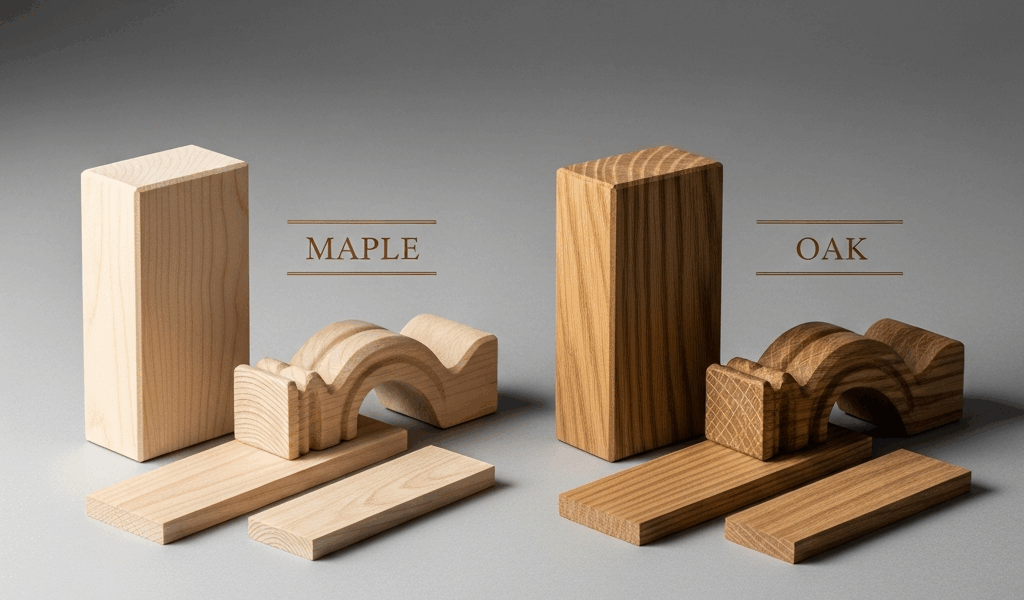
Maple vs Oak for Furniture — Which Wood Should You Choose?
The maple vs oak debate has more noise than signal these days. As someone who’s spent fifteen years making custom pieces out of a 900-square-foot workshop in rural Vermont, I figured out most of what you need to know.
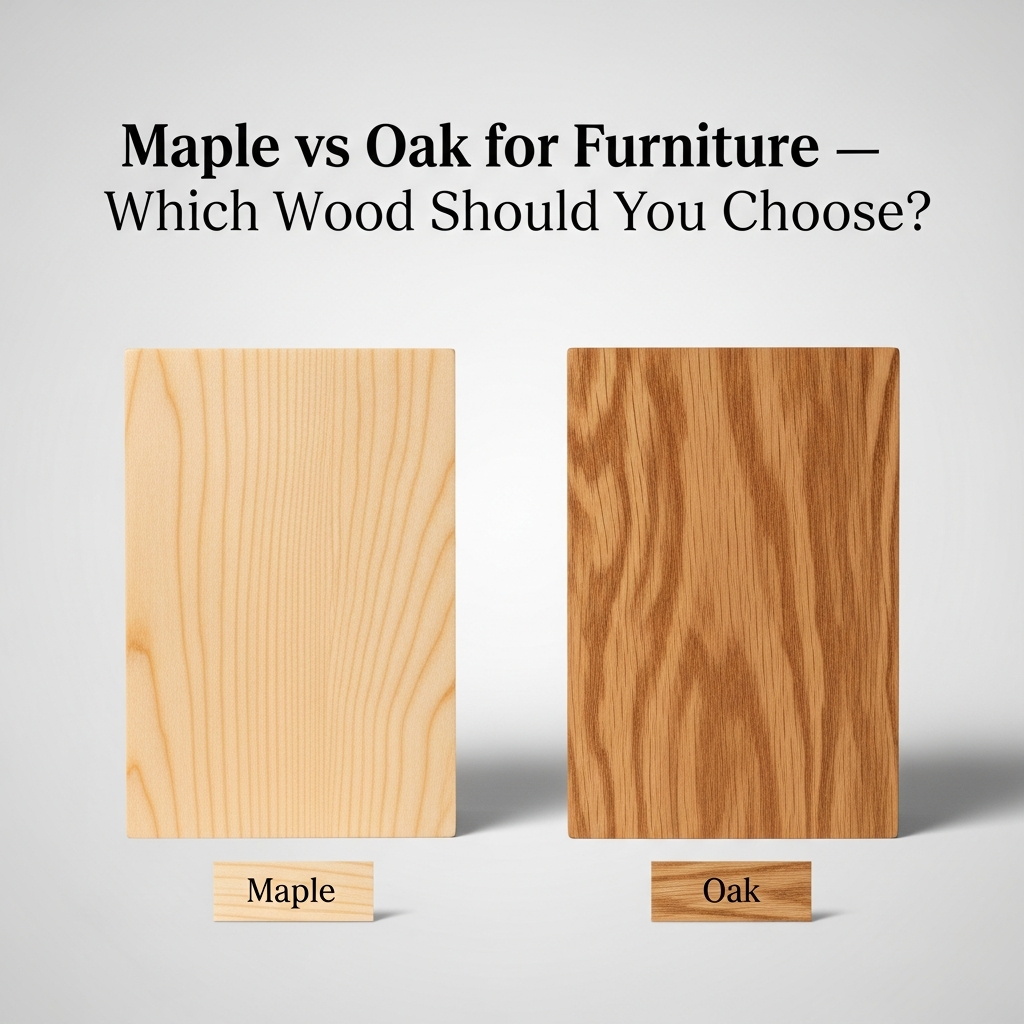
Both woods are genuinely excellent. Honestly, that’s the real answer. But excellent in different ways, for different projects, for different clients with wildly different expectations. Here’s what actually matters.
Maple vs Oak — The Quick Comparison
Probably should have opened with this section, honestly — it’s what most people are scrolling to find anyway.
| Property | Hard Maple | Red Oak |
|---|---|---|
| Janka Hardness | 1,450 lbf | 1,290 lbf |
| Grain Pattern | Fine, subtle, tight | Coarse, open, pronounced |
| Color (raw) | Creamy white to pale yellow | Pinkish-brown to light tan |
| Workability | Can be difficult — burns easily | Forgiving, easy to shape |
| Staining | Blotches without conditioner | Takes stain evenly |
| Cost (board foot, rough sawn) | $5–$7 | $4–$6 |
| Best Use Cases | Cabinets, cutting boards, floors | Dining tables, chairs, case goods |
A few things in that table deserve more than a cell’s worth of explanation. Hardness, for instance. Maple being harder than oak surprises almost everyone — they assume oak, because it sounds more substantial, more serious, must be the tougher wood. It’s not. Hard maple sits near the top of domestic hardwoods for dent resistance. That matters enormously for certain applications and almost not at all for others.
Grain pattern is where the real personality split happens. Oak has wide, open pores and a ray pattern that creates those distinctive fleck marks — especially in quartersawn cuts. It announces itself. Maple is quieter. Finer grained, more uniform, almost milky when freshly milled. Neither is better. They’re just telling different stories.
How Each Wood Works in the Shop
This is where I have the strongest opinions. Working with these two species daily is a completely different experience, and I’d argue craftsmen — not material property charts — are the right source for this kind of information.
Milling and Surfacing
Oak is forgiving. Run a board of red oak through my 20-inch Powermatic drum sander and it comes out clean with almost no drama. Joint it, plane it, rip it on the table saw — it behaves predictably. The open grain structure means less heat from friction, and the wood itself has enough give that blades don’t labor the way they do with harder species.
Maple is a different animal entirely. Take it from me — I found this out the hard way on a kitchen cabinet job about eight years ago, when I ran hard maple stiles through a router table using a straight flute bit I’d been using on softer woods all week. The maple burned. Badly. Scorch marks along the full length of four stiles I’d already spent an hour milling to thickness. Wasted material, wasted afternoon. Maple demands sharp tooling, higher feed rates, and bits with upcut spiral geometry to clear chips fast and keep heat down.
I now use Freud’s 77-102 up-spiral bit for maple profiles specifically and run my router table at a faster feed than I do for cherry or walnut. The wood wants to move through the cutter — not linger against it.
Staining and Finishing
Oak takes stain beautifully. The open pore structure absorbs finish evenly, and the existing grain character means even a simple Minwax Early American (225) gives you a rich, dimensional look with almost no prep beyond sanding to 150 grit. Clients who want a specific tone — darker, more traditional, something matching existing trim — almost always get exactly what they’re picturing when they point at a color chip.
Maple is a different problem. Apply the same stain without prep and you’ll get blotching — dark patches where the grain is tighter or where end grain is partially exposed at the surface. The Minwax Pre-Stain Wood Conditioner helps, but honestly, I’ve had better results using a washcoat of dewaxed shellac — I use Zinsser SealCoat, thinned about 10% with denatured alcohol — before any pigmented stain. It seals the absorption inconsistencies and gives you a much more even color take.
That said — and this matters — maple looks spectacular with a clear finish. No stain at all. Just a good film finish that lets the natural color breathe and shows off any curly or bird’s-eye figure if you’re working with figured stock. For a lot of maple projects in my shop, I talk clients out of staining entirely. That’s the part about maple that woodworkers who appreciate subtlety understand best. it rewards restraint.
Joinery
Both woods hold joinery well. Mortise and tenon, dovetails, box joints — neither gives me problems there. Maple’s hardness makes it excellent for drawers and other wear-heavy joinery specifically because it resists rounding over at contact points. Oak’s larger pore structure means glue joints can be slightly more variable in strength if surfaces aren’t freshly prepared, but that’s a minor concern with proper technique — a concern that mostly disappears if you’re gluing within an hour of milling.
Durability and Aging — How They Look in 10 Years
This is a question I genuinely love getting from clients, partly because the answer involves a kind of material philosophy most furniture buyers haven’t considered before walking into my shop.
Oak develops character with age. That pinkish-tan color deepens and warms over years of light exposure. The grain becomes more visually pronounced as the surface acquires the micro-texture of real use. An oak dining table that’s been in a family for a decade looks richer than the day it was delivered — provided it’s been maintained reasonably well. There’s a reason oak has been the go-to for European furniture construction for centuries. It ages with dignity.
Maple stays lighter. It has some photosensitivity and will yellow slightly over time — more of a warm cream than stark white — but it doesn’t darken the way walnut or cherry does. Clients who want a piece that remains bright and clean-looking long-term are often best served by maple. Think Scandinavian design sensibility — rooms with white walls and lots of natural light. Maple fits that aesthetic in a way oak’s heavier grain presence doesn’t always match.
Finish Durability
Both woods hold up well under a quality film finish. I primarily use General Finishes Arm-R-Seal — an oil and urethane blend — for furniture topcoats on both species. Three coats, sanded to 320 between coats two and three. On oak, the final surface has a slightly more tactile quality — the open pores create micro-relief even in a well-filled finish. On maple, the surface can be polished nearly glass-smooth.
For heavy-use surfaces like dining tables, I’ve been increasingly reaching for Rubio Monocoat oil on oak specifically. It penetrates the open grain, hardens in place, and allows for spot repairs that a film finish won’t accommodate as gracefully. With maple, penetrating oils are less effective precisely because of that tight grain structure — film finishes remain the better choice there, full stop.
Dents and Scratches Over Time
Maple wins on dent resistance. That 1,450 Janka rating means everyday abuse — chair legs dragging across the surface, kids doing what kids do, dropped utensils — leaves less of a mark than it would on softer species. Oak, at 1,290 lbf, is still harder than most domestic hardwoods including cherry and walnut, so it’s not fragile. But if someone is specifically worried about surface damage in a high-traffic home, maple is the right call.
Which to Choose for Your Project
Here’s what I actually tell clients, broken down by project type. These aren’t theoretical recommendations — they’re the choices I’ve watched hold up over years of follow-up conversations and the occasional “hey, remember that table you built me?” text message.
Dining Tables — Oak
Oak is my default for dining tables. The open grain hides fine scratches better than maple does — and that matters on a surface getting daily use and the occasional key dragged across it by accident. The visual warmth of oak grain reads beautifully at large scale. A 96-inch slab of quartersawn red oak is genuinely stunning in a way that a maple slab of equivalent size often isn’t, because maple’s subtlety can disappear at scale. Oak also takes on the kind of patina that makes a dining table feel like an heirloom over time. That’s the whole point, really.
Kitchen Cabinets — Maple
Maple dominates the cabinet world for good reason. The tight, consistent grain means painted surfaces look clean and smooth — no grain telegraphing through paint over time, which is a real issue with oak’s open pores under white or light-colored paint. For natural-finish cabinets, maple’s light color keeps a kitchen feeling bright. And that hardness means door edges and face frames resist constant bumping and abrasion far better than softer alternatives.
Bedroom Furniture — Either, Depending on the Room
Bedroom furniture sees lower abuse than dining or kitchen pieces, so the durability argument matters less here. It comes down almost entirely to aesthetics. Lighter room, contemporary style, white or light-gray walls — maple. Warmer room, traditional or transitional style, existing wood tones already in the space — oak. I’ve built beautiful bedroom sets in both, and the decision is almost always driven by what the client’s bedroom already looks like when I walk in for the measure.
Chairs and Seating — Oak for Solid, Maple for Bent Parts
This one surprises people. Chair construction involves significant stress at joints, and both woods handle that well in straight-grain cuts. But for bent lamination work — steam-bent back slats, curved aprons — maple’s flexibility and grain consistency make it more predictable in the bending process. Frustrated by inconsistent results with oak bent components, I picked up an old Windsor chairmaking book at an estate sale in Woodstock about six years ago and started experimenting with maple specifically for those parts. The results were significantly more consistent. Apparently this wasn’t new knowledge — just new to me.
Cutting Boards and Small Shop Projects — Maple
Maple is the classic American cutting board wood for a reason. The hardness resists knife marks, the tight grain doesn’t harbor bacteria the way open-grained woods can, and the light color shows you immediately when the board needs cleaning. I use hard maple end-grain blocks almost exclusively for cutting boards in my shop. Not a single complaint in fifteen years — which, if you’ve dealt with clients before, you know is basically a miracle.
At the end of the day, both maple and oak have been making excellent furniture for hundreds of years. The question was never which one is better — it’s which one is right for what you’re building, how you want it to look in a decade, and what kind of daily abuse it’s going to absorb. Walk into any shop worth its salt and you’ll find both in the lumber rack. I’ve got about 200 board feet of each right now. I expect to keep it that way.

Stay in the loop
Get the latest classic custom wood furniture updates delivered to your inbox.