What Is Snipe and Why Does It Happen
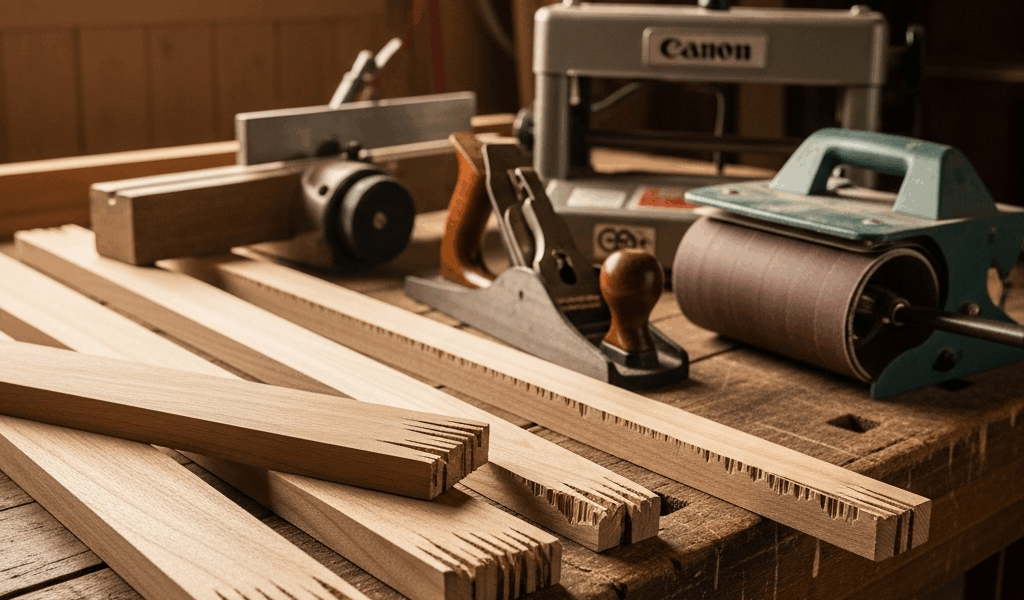
Wood planer snipe has gotten complicated with all the conflicting advice flying around. But let me back up. Snipe is that deeper cut — the nasty one — that shows up in the first 1 to 6 inches at the front or back of a board. Sometimes both ends. The middle looks perfect. Then it drops. We’re talking 1/32 inch to 1/8 inch deeper than the rest of the surface. It’s like the planer decided your workpiece looked too good and took a bite out of it right at the worst possible moment.
Here’s the mechanical reality. The infeed roller grabs your board first. It pulls forward, applies downward pressure, keeps everything flat against the bed. But for a split second — just a brief, maddening moment — the leading edge isn’t fully supported. It tips slightly upward before it contacts the rear roller. The cutterhead doesn’t care. It planes that slightly raised surface anyway. Deeper cut. Right at the nose. Then the same thing happens in reverse when the board exits. The trailing end tips up as it leaves outfeed support. Boom. Snipe at the tail too.
Common Causes of Snipe on Benchtop Planers
Most snipe comes from technique. Some comes from machine setup. As someone who blamed a DeWalt DW735 for six full months before actually troubleshooting properly, I learned everything there is to know about this problem the expensive way. Don’t make my mistake.
First culprit: infeed and outfeed tables that aren’t sitting flush with the planer bed. If your outfeed table is even 0.01 inches lower than the bed, boards drop onto it as they exit. That tips the trailing end upward. You get trailing snipe every single pass, like clockwork. Grab a straightedge and some feeler gauges. Some models let you adjust those tables with a standard wrench. Others don’t budge at all — which is its own frustrating story.
Second cause is hogging too much material in a single pass. Running a board through at 1/4-inch depth stresses the whole feed system. The board wants to lift under that cutter pressure, especially when infeed roller tension is set too light. Drop to 1/16 inch or even 1/32 inch on that final pass. Snipe can disappear almost instantly. It’s almost insulting how simple that fix is.
Third — and I see this constantly — no outfeed support whatsoever. Long boards need something waiting for them as they exit. A roller stand set at the same height as the outfeed table solves this. So does a second person standing at the back. The board drops when unsupported. The end lifts. Snipe happens. That’s just physics being physics.
Fourth: worn or misaligned feed rollers. These apply the pressure holding your board flat. Damaged or tilted rollers won’t distribute that pressure evenly across the width. You’ll see inconsistent snipe — left side one pass, right side the next, both sides the pass after that. This one usually means service, not a technique adjustment.
Leading-end snipe points to infeed table misalignment or weak infeed roller pressure. Trailing snipe suggests the same problem at the outfeed end, or missing support as the board clears the machine entirely.
How to Prevent Snipe Before You Make the Cut
Probably should have opened with this section, honestly. Prevention beats fixing every time, and it costs nothing but setup time.
Set up outfeed support first. Position a roller stand — they run about $40 to $80 for a decent pair at any woodworking supply — so its rollers sit exactly level with your outfeed table. No roller stand? Find a helper. Tell them one thing: hold the board up, don’t push or pull. Let the planer do what it does. Their only job is preventing that trailing end from dropping.
Use sacrificial boards. This is the single best snipe prevention method I’ve ever found, and it’s almost stupidly simple. Take two scrap pieces roughly the same thickness as your good stock. Butt them end-to-end against your workpiece. Feed the whole three-board assembly through as one unit. The leading scrap eats the leading snipe. Your good board rides through the middle, completely protected. The trailing scrap eats the trailing snipe. You burn some scrap. Your actual workpiece comes through clean. That’s the trade.
Keep your final pass light. Planing from 3/4 inch down to 5/8 inch? Do it in two passes — take off 1/8 inch first, then follow with 1/16 inch. That second pass barely stresses the system. The forces that cause lifting drop dramatically.
Once the feed rollers grab the board, let go. Completely. The second your hands touch that board after engagement, you’re introducing variables the planer wasn’t expecting. Hands off, step back, watch the back end. The machine actually knows what it’s doing.
Some woodworkers tilt the outfeed table up by about 1/16 inch on very long boards. The subtle angle means the board won’t drop as it exits. Test this on scrap first — too much angle and you’ve just traded one problem for another.
How to Fix Snipe That Already Happened
Two realistic options here, and which one works depends on snipe depth and how much board length you can actually afford to sacrifice.
Option one: cut it off. Snipe running 1 to 2 inches long and the project has some flexibility? Crosscut that end. Miter saw, circular saw, band saw — whatever you have. Take 3 inches off each end to be safe. Problem gone. This works particularly well on boards you’re already cutting into multiple shorter pieces anyway.
Option two: sand it out. Shallow snipe — under 1/32 inch — surrenders to a random orbital sander with 120-grit paper in about 30 seconds. Just don’t sand the surrounding surface away chasing it. A card scraper actually works beautifully on shallow snipe, especially on pieces you’ve already finished or stained. Scrapers are precise. They take only what you ask them to take.
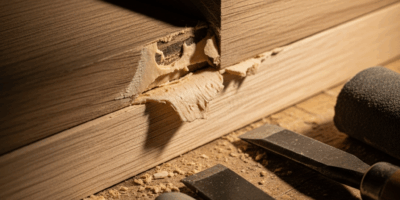
But here’s the honest part nobody says clearly enough: snipe deeper than 1/16 inch on a board only 4 or 5 inches wide cannot be sanded out cleanly. You’ll level the snipe, sure — but you’ll have sanded the whole board unevenly in the process. The surface dulls. The geometry changes. At that point, you’re cutting off the end or starting over. Those are the two options. Pick one.
When to Adjust Your Planer vs Change Your Technique
So, without further ado, let’s actually diagnose this properly instead of just throwing solutions at the wall.
Every board sniped — same depth, same location, regardless of technique? Check your tables. Alignment problems are consistent, almost boringly so. Snipe only happening sometimes, or varying based on how you feed the board? That’s technique. Support stands, sacrificial boards, lighter passes. No service call required.
Check your manual for infeed and outfeed roller pressure settings. Some benchtop models actually let you adjust this. I’m apparently someone who ignored this section for years, and my DeWalt DW735 has a small lever on the side for exactly this purpose. Tightening infeed roller pressure can reduce leading snipe when the feed system — not your process — is genuinely the cause.
Most snipe is user error. That’s not an insult — it’s actually good news. It means you control the fix. Better support, lighter final passes, sacrificial boards on either end. Whatever frustration you’re feeling right now? It’s fixable today, probably before lunch.


Stay in the loop
Get the latest classic custom wood furniture updates delivered to your inbox.