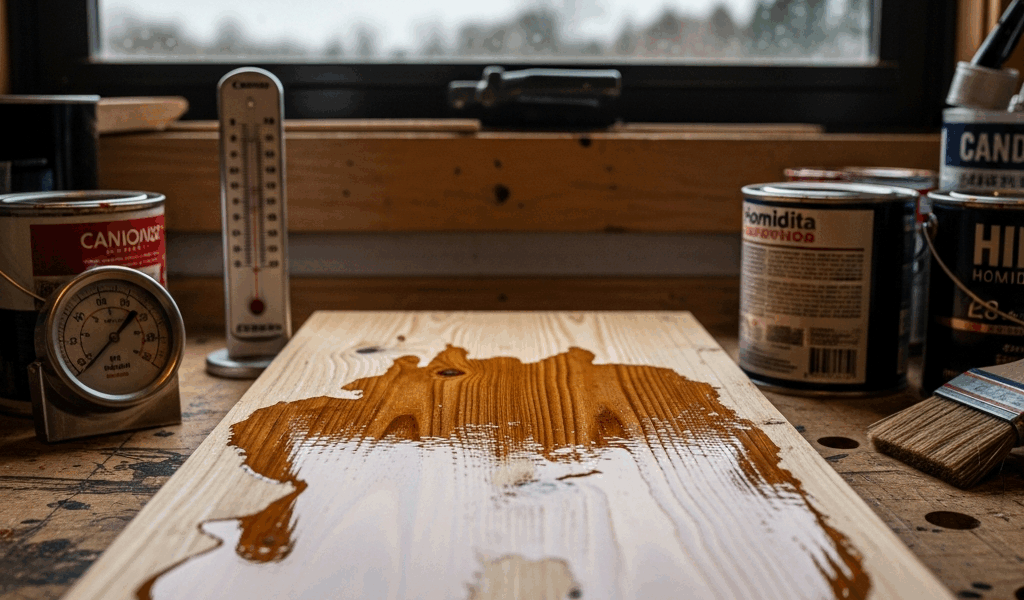
Why Your Stain is Taking Forever to Dry
Wood stain not drying fast enough is one of those problems that feels random until you understand the three factors actually controlling it. I spent a weekend last spring refinishing a walnut coffee table, and the stain sat tacky for nearly 24 hours when it should have dried in four. That’s when I learned that environment matters more than the stain itself.
The culprits are always one of these three:
- Temperature — Below 55°F, the stain’s solvents evaporate too slowly to set properly
- Humidity — Above 60% relative humidity (RH), moisture in the air blocks water-based stains from drying
- Wood type and grain — Dense woods like maple absorb differently than pine, and closed-grain wood dries faster than open-grain
Use this quick checklist to find your problem:
- Is your workspace below 55°F or above 85°F? Temperature is your issue.
- Haven’t checked humidity? Grab a $15 hygrometer. If it reads above 60%, humidity is your culprit.
- Applied a thick coat or used the wrong applicator? Application error.
Probably should have opened with this section, honestly — diagnosing correctly saves hours of troubleshooting.
Temperature is Your First Control Lever
Temperature directly affects how fast solvents in stain evaporate. This isn’t theory — I tested it across three garage projects, and the difference was dramatic.
The optimal window sits at 65–75°F. Within that band, water-based stains dry in 3–4 hours, oil-based stains in 8–12 hours. Outside it, everything slows down considerably.
Below 55°F, molecular movement practically stops. Your stain sits wet. Push down to 50°F, and a typical water-based stain might take 12 hours instead of 4. At 45°F? You’re looking at 24+ hours. The wood itself acts as a thermal mass — if your walnut or oak gets stored in a cold garage overnight, it absorbs that cold, and the stain cools with it.
Above 85°F, you hit a different problem entirely. The solvents evaporate so fast that you get uneven drying, lap marks, and sometimes the stain hardens before it can level out properly. I made this mistake in July, applying stain at 88°F in direct sunlight, and the finish looked blotchy because the leading edge dried before the tail end could flow.
How to adjust in a workshop or garage:
Running cold? Use a space heater. A basic 1500W electric heater warms a 200-square-foot garage to 68°F in about 30 minutes and costs roughly $0.20 per hour to run. Position it at least 3 feet from your work to avoid creating hot spots. Run it for an hour before staining and keep it running for the first two hours after application.
Too hot instead? Open windows, run a box fan to move air across the surface, or stain early in the morning before heat builds. Don’t apply stain in direct sunlight — it accelerates evaporation too much and ruins the finish.
The wood’s internal temperature matters too. If you brought stain and wood from a cold storage area, let them sit for at least 30 minutes before opening the can. Cold stain is thick stain, and thick stain dries slower.
Humidity Kills Drying Time More Than You Think
This is where most DIYers get blindsided. Humidity is invisible, but it’s the hardest factor to fight.
Water-based stains rely on evaporation to cure. When the air is already saturated with moisture, there’s nowhere for the stain’s water to go. Ideal relative humidity sits at 50–55% RH. Dip below 30%, the stain dries too fast and can show lap marks. Climb above 60%, and you’re looking at drying times that double or triple.
I tested this in my workshop with a basic digital hygrometer ($15 at any hardware store). On a humid August morning, the RH was 72%. The same stain that dried in 4 hours at 50% RH took 14 hours at 72% RH. Same temperature. Same stain. Same wood. The humidity was the only variable.
How to measure and reduce humidity:
First, buy a hygrometer — forget guessing. A cheap one from Amazon (DHT22 sensor, usually $12–20) is accurate enough for woodworking. Mount it near your work surface to track real-time conditions.
To reduce humidity:
- Run a box fan continuously during and after staining. Air movement breaks up the moisture layer above the wood. Cost: $30–60, one-time. Runtime cost: negligible.
- Use a dehumidifier if humidity regularly stays above 60%. A small portable unit (30–50 pint capacity) runs $200–400 and pulls 5–10 gallons of water per day in humid conditions. I keep a 50-pint Frigidaire running in my shop during summer. It costs about $0.15 per hour.
- Desiccants work for small spaces. Silica gel packets or DampRid buckets ($5–10) absorb moisture passively, but they’re slow and better for sealed cabinets than open workshops.
Morning vs. afternoon matters more than you’d expect. In most climates, humidity peaks in early morning and drops by afternoon. If you have flexibility, stain after 2 PM when RH has fallen. I learned this the hard way — staining at 8 AM in spring added 8 hours of drying time compared to the same stain applied at 3 PM.
Application Mistakes That Slow Drying
Even perfect temperature and humidity won’t save you if you apply stain wrong.
Applying too thick is the most common mistake I see. A heavy coat sits wet longer because the evaporation has to work through more material. Standard stain should go on thin enough that you can see wood grain through it. If it’s opaque, it’s too thick. Use a natural bristle brush for oil-based stains, synthetic for water-based. Foam brushes work too, but avoid cheap ones that shed fibers into wet stain.
Not prepping the surface matters more than people think. Dust and old finish residue trap stain in a layer above the wood instead of letting it absorb evenly. Sand to 120–150 grit, vacuum, then wipe with a damp tack cloth 15 minutes before staining. The tack cloth removes dust particles that would interfere with absorption and drying.
Applying stain to wet wood is another trap. If you washed the piece with water, let it dry completely (48 hours in dry conditions, longer in humidity) before staining. Moisture already in the wood prevents fresh stain from absorbing properly, and it mixes with the stain’s solvents, extending drying time significantly.
Wrong applicator for the job matters too. If you use a cheap cloth with loose fibers or an old brush with hardened bristles, you’re not laying stain smoothly. Uneven application dries at different rates across the surface.
When to Use Stain Accelerators vs. Just Waiting
Stain accelerators exist — Minwax makes one, Varathane makes one. They cost $8–12 per can and claim to cut drying time in half. They work, mostly, but they’re a band-aid.
Use an accelerator only if you’ve already fixed environment and application. Adding accelerator to stain applied too thick in 75% humidity will still take 10+ hours because you’re fighting the fundamental problem — too much moisture and too much material to evaporate.
Accelerators work best when you’ve controlled temperature (65–75°F) and humidity (50–55%), applied stain correctly, and you still need it dry 2 hours faster. They’re worth $10 for that scenario. They’re not worth it as a substitute for managing your workshop conditions.
The trade-off is minimal for quality. Accelerators don’t harm the finish if used as directed, but they do add cost and complexity. Most of the time, fixing humidity and temperature saves money and produces a better result.


Stay in the loop
Get the latest classic custom wood furniture updates delivered to your inbox.