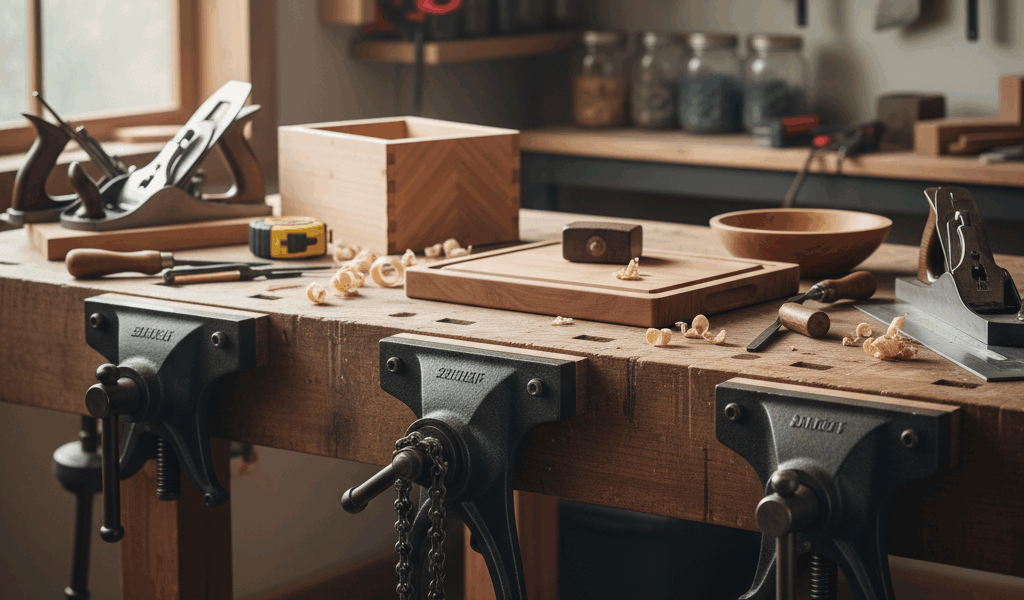
Workbench vise options have gotten complicated with all the boutique manufacturers and vintage reproductions flying around. As someone who has installed and used just about every type of vise over the years, I learned everything there is to know about picking the right one for your bench and your work style. Today, I will share it all with you.
Types of Vises and What They Do Best
Face vises mount to the front of your bench and are what most people picture when they think of a woodworking vise. You clamp a board vertically for dovetailing, edge-up for planing, or flat against the bench apron for all sorts of operations. Every workbench needs a face vise. It is the most versatile clamping device on the bench.
Tail vises sit at the end of the bench and work with bench dogs to clamp workpieces flat on the benchtop for face planing and sanding. The combination of a tail vise and a row of dog holes gives you incredibly solid workholding across the entire length of your bench. That’s what makes a proper vise setup endearing to us hand tool woodworkers — it turns a table into a precision clamping system.
Twin-screw vises use two parallel screws to clamp wide panels flat against the front of the bench. They apply even pressure across wide boards without the racking that single-screw vises sometimes cause. I use mine for clamping wide panels when edge-planing and for holding boards for hand-cut joinery. If you work with wide stock regularly, a twin-screw vise is a game changer.
Quick-release mechanisms speed up the open-close cycle dramatically. You pull a lever, the jaw slides freely, then it re-engages the screw threads when you let go. For work where you are constantly loading and unloading pieces, quick-release saves a surprising amount of time and wrist fatigue.
Size and Weight Considerations
Probably should have led with this section, honestly. Bigger is not always better when it comes to vises, and I have seen people put enormous vises on benches that cannot support them.
Larger jaws hold more work and distribute clamping pressure more evenly, which reduces the chance of marring your workpiece. But heavy vises require sturdy benches. A fifty-pound vise bolted to a wobbly particleboard bench is a recipe for frustration and possibly an injury. Make sure your bench can handle the weight before you buy.
Consider mounting height and reach. The top of your vise jaws should be flush with the benchtop surface. If the vise is too high, your bench dogs will not line up. Too low and you lose clamping area. Measure carefully before cutting your mounting pocket.
Match the vise to your typical work. If you are building jewelry boxes, you do not need a twelve-inch face vise designed for timber framing. A seven or nine-inch vise handles furniture-scale work perfectly for most people.
Protecting Your Workpiece
Metal vise jaws will mar your wood every single time unless you add protective faces. Wooden jaw faces are the most common solution — just screw or bolt a pair of hardwood blocks to the inside of the vise jaws. I use maple for my jaw faces because it is hard enough to last but soft enough not to dent most project woods.
Leather or cork liners are alternatives that grip well and protect finished surfaces. I keep a set of leather-lined jaw pads for when I am working on already-finished pieces that cannot take any marks at all. Replace jaw faces when they get chewed up. They are sacrificial parts — meant to take the abuse so your workpieces do not.
Installation Tips From Experience
Mount the vise securely to your bench structure, not just to the top. The forces involved in heavy clamping are significant, and a vise that pulls loose during work is dangerous. I bolt through the bench apron and into the leg structure with carriage bolts and washers.
Check alignment before final fastening. Open and close the vise through its full range to make sure the jaw tracks straight and parallel. A misaligned vise either binds on one side or leaves a gap, and neither situation gives you good clamping pressure. Adjust as needed and re-test over time — wood benches move with the seasons and you may need to tweak things occasionally.


Stay in the loop
Get the latest classic custom wood furniture updates delivered to your inbox.