Plywood grades have gotten complicated with all the specialty panels and import options flying around. As someone who has bought and used every grade of plywood you can find at the lumberyard, I learned everything there is to know about decoding those letters and picking the right sheet for your project. Today, I will share it all with you.
The Letter System Explained
The grading letters run from A down to D, and they tell you about the face quality of each side of the sheet. Once you understand what each letter means, the whole system clicks.
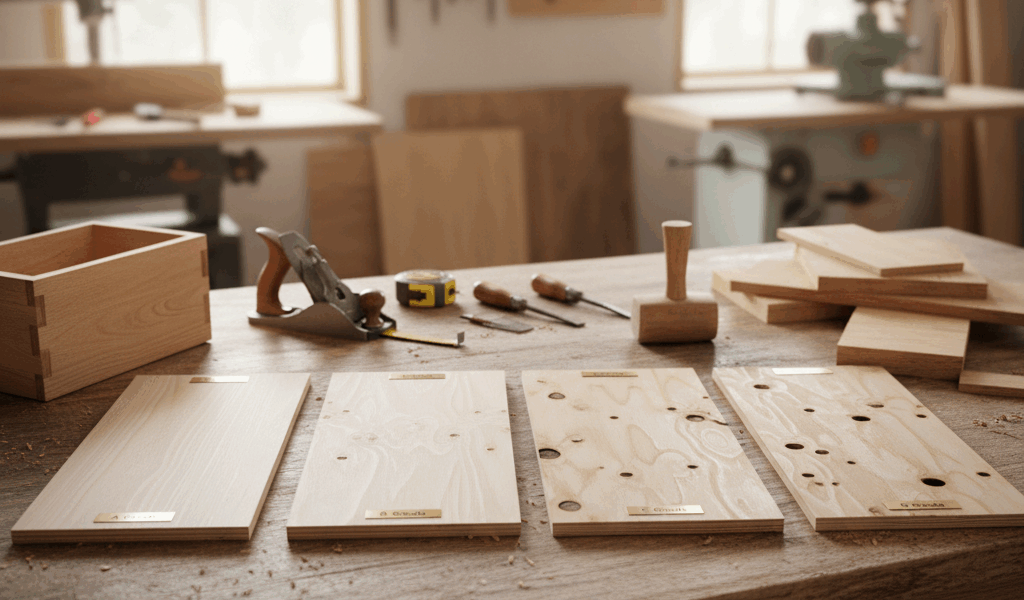
A-grade is the premium face. Smooth, minimal defects, ready for stain or paint without much prep. This is what you want on anything visible. Cabinet doors, furniture panels, the good side of a bookcase — A-grade faces look the part.
B-grade allows some repairs. You will see patches, plugs, and minor filling. Still a decent-looking surface that can be painted to look nearly flawless, but not ideal for clear finishes where you want perfect grain. I use B-grade faces on pieces where paint is the plan.
C-grade gets rougher. Knots, small voids, and more visible defects. This is structural plywood territory. It holds screws and supports weight just fine, but nobody is putting a clear finish on a C-grade face. At least not on purpose.
D-grade is the rough stuff. Knotholes, splits, and repair patches everywhere. Use it where nobody will ever see it — cabinet backs against the wall, hidden structural elements, shop fixtures.
Two Letters — Two Faces
Probably should have led with this section, honestly. When you see a grade like A-C, the first letter is the better face and the second is the back. So A-C means one beautiful face and one rough face. Perfect for cabinets where only the front shows and the back goes against the wall.
B-B gives you a decent surface on both sides. Good for utility shelving where both faces might be visible. C-D or CDX is construction grade — the X means the glue is exterior rated. Subfloors, sheathing, roof decking. You will never use CDX for furniture, but it is great for shop jigs and fixtures where appearance does not matter.
That’s what makes understanding plywood grades endearing to us woodworkers who watch our budgets — you stop paying for quality you do not need on hidden surfaces.
Core Types Make a Big Difference
Veneer core is the standard — layers of thin wood stacked with alternating grain direction. Strong, relatively light, and holds screws well. This is what most furniture-grade plywood uses, and it is my default choice for cabinet carcasses and shelving.
MDF core gives you incredibly smooth and flat faces, which is why it is popular for painted work. The downside is weight — an MDF core sheet is noticeably heavier than veneer core — and screws do not hold as well in the MDF edge. I use MDF core for cabinet doors that will be painted because the faces are dead flat and take primer beautifully.
Particle board core is the economy option. Cheapest and heaviest. The faces chip more easily and the core does not hold fasteners well. I use it only when budget is the primary concern on utility projects.
What to Actually Buy for Your Project
Cabinet projects: A-C or B-C with veneer core. Good face out, ugly face against the wall. This balances quality and cost perfectly for most built-in and freestanding cabinet work.
Paint-grade projects: MDF core or Baltic birch. Smooth surfaces hide nothing, so you need dead-flat panels that will not show grain telegraph through the paint. MDF core plywood is made for this.
Shop jigs and fixtures: whatever is cheapest. CDX works fine. Nobody is judging the aesthetics of your router templates or your assembly table. I buy construction-grade plywood for jigs without an ounce of guilt.
Baltic birch deserves special mention. It is void-free throughout every layer, made entirely of birch plies, and the edges are beautiful enough to leave exposed. It is more expensive than standard plywood, but for drawer boxes, exposed-edge shelving, and shop furniture where you want to see those lamination lines, it is absolutely worth the premium. I build all my drawer boxes from Baltic birch and the edge detail is a feature, not something to hide.


Stay in the loop
Get the latest classic custom wood furniture updates delivered to your inbox.