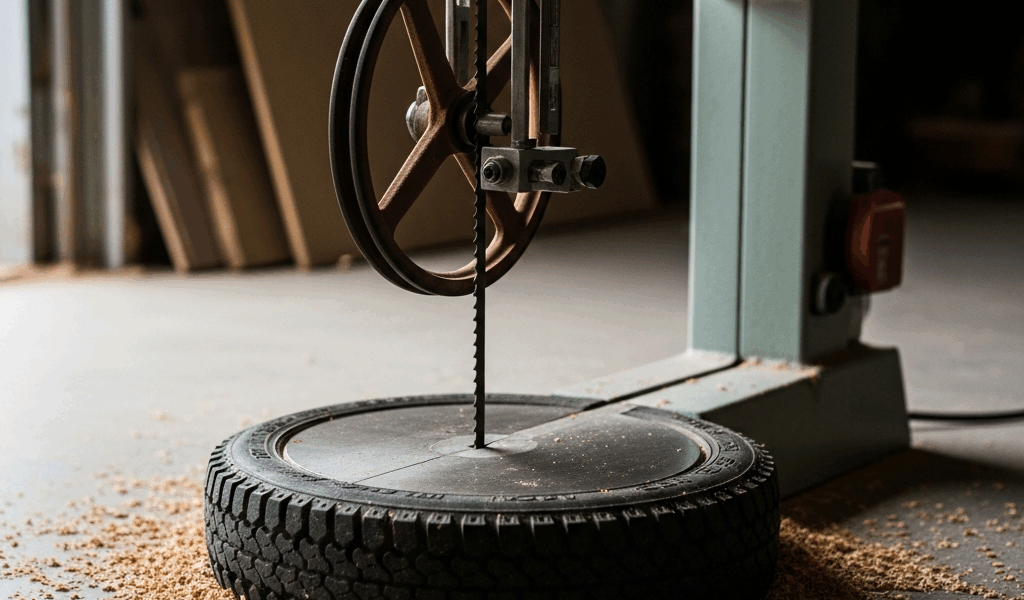
The blade just popped off the wheels again — mid-cut, probably while you were resawing something important. It’s one of the most annoying things a bandsaw can do, and it makes you not trust the machine. The good news is that there are really only five things that cause this, and the most common fix takes about thirty seconds.
Check Blade Tension First
Under-tensioning accounts for the vast majority of blades coming off wheels. If the blade isn’t pulled tight enough, any lateral force during a cut — hitting a knot, feeding at an angle, or the natural flex of resawing — pushes it sideways off the tire crown. It doesn’t take much.
Here’s the quick test. With the saw unplugged, press the blade sideways at the midpoint of the unsupported span — that’s the section between the upper and lower guides. It should deflect no more than about 1/4 inch under moderate finger pressure. If it moves 1/2 inch or more, you’re way under-tensioned.
Crank the tension knob until the deflection feels right, then run a test cut on scrap. If the blade tracks straight and doesn’t wander during a curve cut, you’re in the zone. Most bandsaws have a tension scale on the housing — those marks are a decent starting point, but they’re not gospel. A 1/2-inch blade on one brand’s “1/2 inch” mark might be perfect or might be loose. Trust the deflection test over the scale.
One important caution: over-tensioning is almost as bad as under-tensioning. Too much tension accelerates bearing wear and can actually crack the blade at the weld. It can also cause the blade to break mid-cut, which is loud, startling, and potentially dangerous. If you’ve cranked the tension way past the marked range and the blade still comes off, tension isn’t your problem — move on to tracking.
A habit worth building: loosen the tension when you’re done for the day. It takes five seconds and saves your tires, bearings, and blade from sitting under constant load overnight or all weekend. This is one of those things experienced bandsaw users do automatically that beginners never think about.
Tracking Adjustment — Step by Step
Tracking is how the blade sits on the wheels. On most bandsaws, the upper wheel tilts slightly to steer the blade forward or backward on the tire surface. If tracking is off, the blade gradually walks to one side and eventually rolls right off the wheel.
Start with the saw unplugged and the blade properly tensioned. Open both wheel covers so you can see what’s happening. Spin the upper wheel slowly by hand and watch where the blade rides on the tire. On most saws, you want the blade centered on the tire crown — that slight hump in the middle of the rubber. Some woodworkers prefer the blade riding just behind center, with the teeth hanging slightly off the front edge. Either approach works, but centered is the safest starting point.
The tracking adjustment is a knob or bolt on the back of the upper wheel housing. Turn it in small increments — quarter turns at most. Spin the wheel by hand after each adjustment and watch what happens. The blade should settle into a stable position after two or three revolutions. If it keeps drifting forward or backward, you need another small adjustment.
Once the blade tracks consistently by hand, close the covers and do a powered test. Let the motor come up to speed and listen. A properly tracked blade is nearly silent. A mis-tracked blade makes a rhythmic ticking or scraping noise as it rubs against the inside of the wheel covers.
Critical point: always set tracking with the motor off and the wheel spinning by hand first. Adjusting tracking with the motor running is asking for trouble — the blade is moving too fast to see what’s happening, and if it comes off while you’re reaching for the adjustment knob, your hand is right next to a spinning wheel.
Worn Tires and When to Replace Them
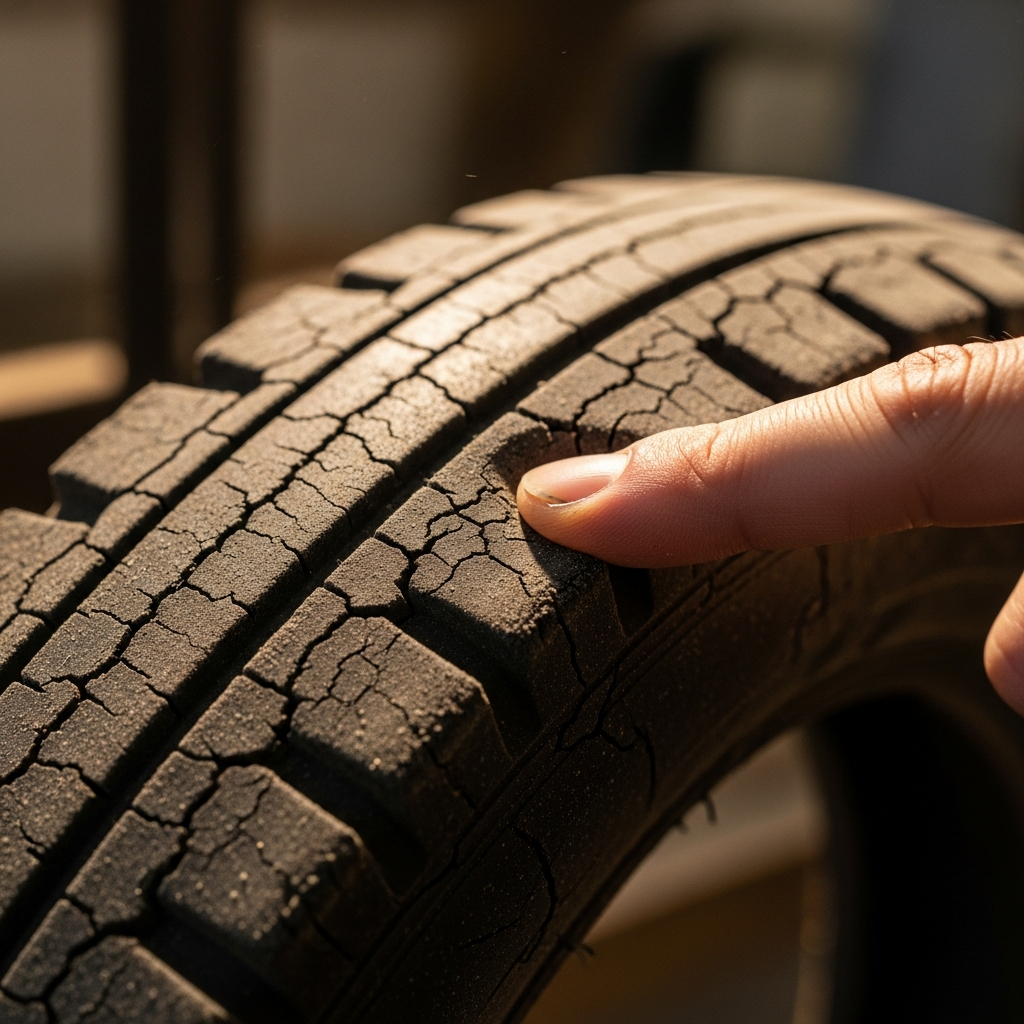
The rubber tires on your bandsaw wheels are doing more work than most people realize. They provide the grip that keeps the blade from slipping, and the crowned shape is what keeps the blade centered. When tires wear out, nothing else you adjust will keep the blade on track.
Pull the blade off and inspect both tires. Here’s what you’re looking for:
Grooves: If you can see a track worn into the rubber where the blade usually sits, the tire has lost its crown. A flat or grooved tire can’t center the blade anymore. Any groove deeper than about 1/32 of an inch is enough to cause tracking problems.
Cracks and hardening: Rubber dries out and gets brittle over time, especially in shops that aren’t climate controlled. Press a butter knife blade into the tire surface. On fresh rubber, it should leave a slight impression that bounces back. If the knife leaves no mark at all, the rubber has hardened past the point of being useful — it’s basically a plastic surface now, and the blade will slide on it instead of gripping.
Uneven wear: If one side of the tire is worn more than the other, the wheel isn’t running true or the blade has been mis-tracked for a long time. Replace the tires and then recheck wheel alignment.
Replacement tires come in two flavors: rubber and urethane. Traditional rubber tires are cheaper ($10–$20 per wheel) but wear faster and harden over time. Urethane tires from companies like Carter or Timberwolf cost a bit more ($15–$30) but last significantly longer and maintain their crown shape better. For a saw you use regularly, the urethane upgrade pays for itself.
Installing new tires can be a fight. Here’s the trick that makes it dramatically easier: drop the tire in boiling water for about five minutes. The heat softens and expands the rubber or urethane just enough that it stretches over the wheel rim without a wrestling match. Let it cool and shrink onto the wheel for a perfect fit. Works every time.
Guide Bearing and Block Alignment
The blade guides — upper and lower — serve two purposes. They keep the blade from twisting under cutting load, and they prevent the blade from being pushed backward off the wheels when you feed stock into it. Misaligned guides let the blade wander, and wandering leads to derailing.
There are two common types of guide systems. Older and budget saws use guide blocks — small metal or composite blocks that pinch the blade on each side. Better saws use bearing guides — small ball bearings that spin with the blade and provide nearly frictionless support.
Regardless of type, the setup principle is the same. The side guides should sit just barely off the blade — close enough to prevent flex, but not actually touching during free spinning. A business card slipped between the guide and blade is a good gauge. The thrust bearing (the one behind the blade) should sit about 1/64 inch behind the blade body, just behind the gullets. It should spin when you’re cutting but not when the blade is running free.
Both the upper and lower guide sets need to be aligned. It’s easy to set the upper guides and forget the lower ones buried under the table. But misaligned lower guides let the blade flex right at the cut line, which creates a sideways force that can walk the blade off the lower wheel.
If you’re running the factory guide blocks that came with a budget saw and fighting constant tracking issues, consider upgrading to Cool Blocks or aftermarket bearing guides. Cool Blocks are composite blocks that won’t damage the blade if they touch, and they’re much more forgiving of imperfect alignment. Bearing guides are the best option if your saw accepts them — they support the blade with almost zero friction and essentially eliminate guide-related tracking problems.
Blade Width Matters — Wrong Size for Your Saw
This catches people more than you’d think. Using a blade that’s too narrow for the job, or too wide for the saw’s wheels, is a recipe for the blade coming off under load.
Here’s the general rule for blade width by task:
- Tight curves and scrollwork: 1/8 to 1/4 inch blade
- General purpose cutting: 3/8 to 1/2 inch blade
- Resawing and ripping: 1/2 to 3/4 inch blade (or wider if your saw takes it)
The problem shows up most often when someone tries to resaw with a 1/4-inch blade. A narrow blade has very little beam strength — it flexes easily under the sideways pressure of resawing, and that flex can push it right off the wheels. It’s like trying to push a piece of string through a board. The blade needs enough width to resist deflection under load.
Going the other direction, there’s a maximum blade width for each wheel diameter. A 14-inch bandsaw typically handles up to a 3/4-inch blade. A 9-inch benchtop saw might max out at 3/8 or 1/2 inch. Using a blade wider than your wheels can accommodate means it won’t seat properly on the tire crown and won’t track correctly no matter what you do.
Quick reference for maximum blade width by wheel size:
- 9-inch wheels: 3/8 inch maximum
- 12-inch wheels: 1/2 inch maximum
- 14-inch wheels: 3/4 inch maximum
- 17 to 18-inch wheels: 1 inch maximum
- 20-inch wheels and up: 1-1/4 inch or more
Check your saw’s manual for the recommended range. If you’re resawing regularly and your saw only takes a 1/2-inch blade, you’ll get better results from a quality 1/2-inch blade with 3 TPI than from forcing a wider blade onto undersized wheels. Blade quality matters more than blade width once you’re within the correct range for your saw.
If your blade keeps coming off only during certain operations — curves but not straight cuts, or resawing but not crosscuts — blade width mismatch is almost certainly the reason. Match the blade to the task, match the task to the saw, and the blade stays put.

Stay in the loop
Get the latest classic custom wood furniture updates delivered to your inbox.