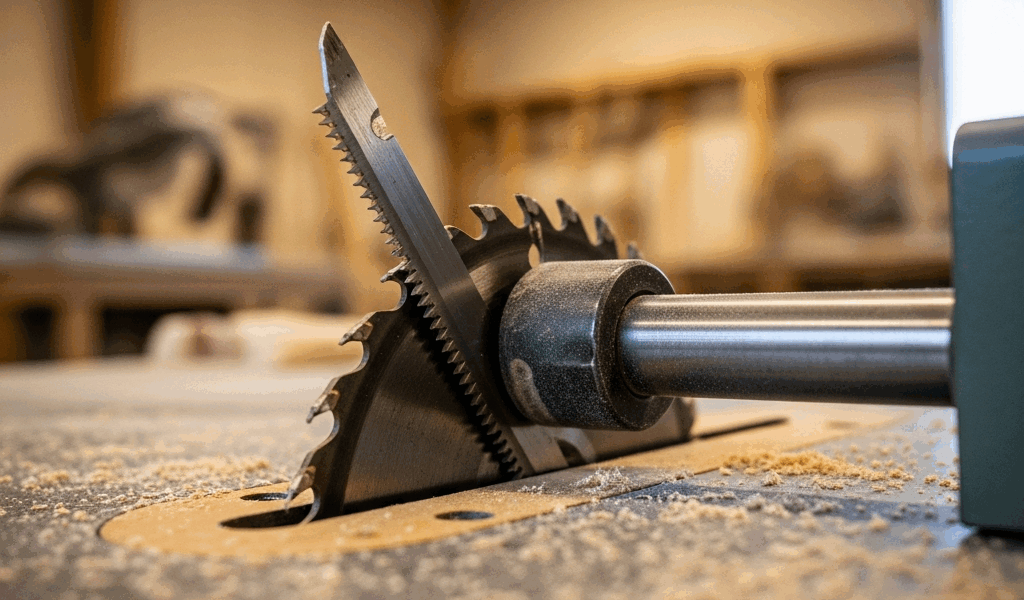
Your table saw blade is wobbling, and every cut comes out looking like it was made with a butter knife. Don’t panic. Before you start pricing new saws or calling a repair shop, there’s one quick test that’ll tell you exactly what’s going on. Most wobble problems have a fix that takes under ten minutes — you just need to know which part is actually causing it.
How to Tell If It Is the Blade or the Arbor
This test keeps you from throwing money at the wrong fix. Set your blade about an inch above the table. Grab a scrap piece of lumber — doesn’t matter what, just something with a straight edge — and rip about 1mm off one side. Barely a shaving. Then kill the power and let the blade come to a full stop.
Now slide that freshly cut board back toward the blade until it just barely makes contact. Pay attention to exactly where it touches. Unplug the saw (seriously, unplug it), then rotate the blade by hand and watch whether the contact point changes.
Here’s what it means. If the rub spot stays in the same position relative to the arbor — the blade always pushes the wood away at the same clock position no matter how you rotate — then the arbor or flanges are crooked. If the tight spot travels with the blade as you turn it, the blade itself is warped. That one test tells you everything.
If you’ve got a dial indicator and a magnetic base, even better. Stick the indicator on the table surface and let it ride against the blade body — not the teeth, the flat plate. Spin the blade slowly by hand. On a contractor saw, anything under 0.003″ of runout is perfectly fine. Between 0.005″ and 0.010″ is worth investigating. Over 0.010″ and yeah, that’s your wobble right there.
Blade Problems — Warped, Cheap, or Wrong Size
More often than not, the blade is the culprit. Those $15 combo blades from the hardware store are stamped from thin steel with pretty loose flatness tolerances. I grabbed a three-pack on sale once — two of the three wobbled out of the box. Not a great batting average.
Quick check: lay the blade on something dead flat. A granite countertop offcut works great, or a piece of plate glass if you have one in the shop. Press the center down and see if it rocks at all. Any rocking means the blade isn’t flat. No amount of flange cleaning or arbor tightening fixes a warped blade.
One thing that catches people off guard — thin-kerf blades wobble more than full-kerf, especially on contractor saws with their longer arbors. Thin-kerf blades are designed for smaller saws that need less material removed per pass, so they’re inherently less rigid. Running a 1-3/4 HP motor or bigger? Try swapping in a full-kerf blade. The wobble might just vanish.
While you’re at it, double-check the arbor hole. Standard is 5/8″ on US table saws. Some imported blades run slightly oversize or have metric bores. Even 0.002″ of slop between the blade hole and the arbor shaft will show up as wobble once the motor’s spinning. And if you’ve been using a bushing adapter — those introduce slop too. They’ll get you through a project in a pinch, but they’re not a permanent solution.
Easiest diagnostic of all: borrow a blade you trust from a buddy, or grab that Freud or Diablo that’s been sitting on the shelf. Mount it, spin it up. If the wobble disappears, you just saved yourself a lot of troubleshooting.
Arbor and Flange Fixes
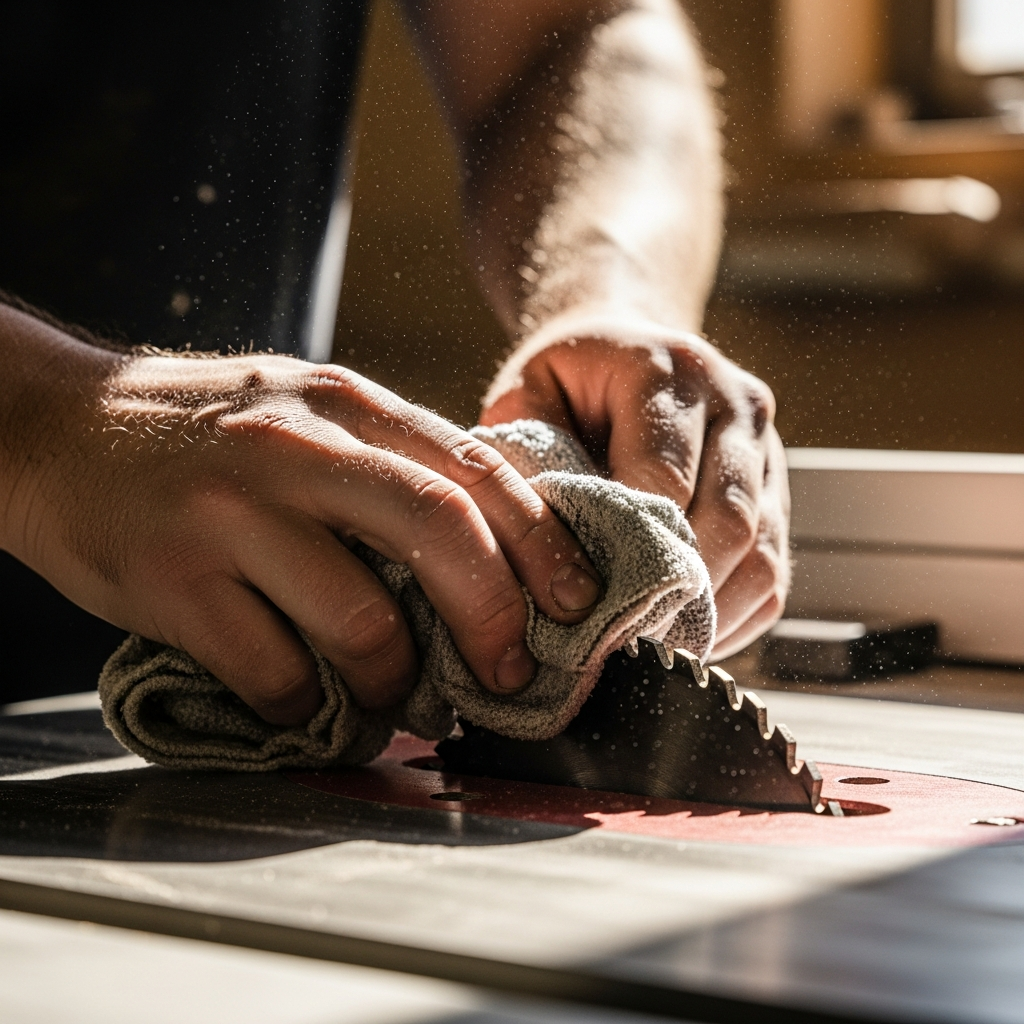
So the diagnostic test pointed to the arbor. Start with the flanges — those two flat metal washers that clamp the blade on either side. One is fixed to the shaft, the other presses against the blade when you tighten the nut. Sawdust, pitch, and dried resin love to accumulate on those faces. Even a thin film will tilt the blade just enough to wobble.
Pull the blade off and look at both flange surfaces. Wipe them with mineral spirits on a clean rag. Check for nicks, dings, or little rust spots. The thing about flanges is that any raised spot gets amplified — a 0.001″ bump right at the flange turns into a much bigger wobble by the time you get to the rim of a 10-inch blade. It’s just geometry working against you.
Got a flange that’s not quite flat? Here’s a trick that’s been around longer than I have. Put a sheet of 400-grit sandpaper grain-side up on a piece of plate glass. Press the flange face down and make slow circular strokes. Keep the pressure even and centered. You’re not trying to remove much material at all — just getting a uniform, shiny contact ring. Usually ten or twenty passes does it. Check often.
Now check the arbor nut. Hand-tight, then 1/8 to 1/4 turn with a wrench. That’s it. I see guys absolutely cranking on that nut like they’re torquing lug nuts, and ironically, over-tightening can distort the outer flange and make the wobble worse. Too loose is bad too — the blade will shift under cutting load. Find the sweet spot.
Don’t forget the threads on the arbor shaft. Gummy, crusty threads keep the nut from seating square. Hit them with a brass brush and some mineral spirits. Skip the steel wool — those tiny metal fragments migrate into places you don’t want them, like your bearings.
If the shaft itself is bent, that’s a different story. A bent arbor gives you constant, unchanging runout no matter what blade you put on or how clean the flanges are. The fix is a new arbor assembly — runs $40 to $120 depending on the saw. On most contractor and jobsite saws it’s a pretty straightforward swap. Four bolts, a belt, maybe an hour of your time.
Bearing Replacement — When Nothing Else Works
Here’s the telltale sign of bad bearings: the blade wobbles like crazy at startup, then seems to calm down once the motor hits full speed. What’s happening is that the worn bearing lets the arbor float around until centrifugal force centers everything up. The wobble isn’t really gone at speed — it’s just less visible. Your cuts will still show it.
To confirm, unplug the saw and pull the blade off. Grab the arbor and try to wiggle it — side to side, up and down. Any play you can feel with your fingers means the bearings are done. Also try spinning the arbor by hand. It should turn smooth with just the faintest resistance. If it feels gritty, rough, or catches at certain points, those bearings are toast.
The bearings themselves are nothing exotic — standard sealed ball bearings you can find at any bearing supplier. The annoying part is getting the right number. Pop one bearing out and look for the number stamped on the outer race. Common sizes for contractor saws are 6203 and 6204. A pair of quality bearings from NTN, NSK, or SKF runs $15 to $30. You can find cheaper ones on Amazon. They’ll work, but the name brands last noticeably longer in my experience.
You’ll need to press the old bearings off and the new ones on. A proper bearing press is ideal, but most of us don’t have one sitting in the garage. A socket that matches the outer race diameter plus a bench vise will do the job. One tip that makes a big difference: warm the new bearing with a heat gun for a minute before pressing it on. The heat expands the inner race just enough that it slides on without fighting you. Never hit a bearing with a hammer — that damages the balls and races before you’ve even used it.
On older saws, also check whether the bearing housing itself is worn. If a new bearing spins freely in its housing instead of being a tight press fit, the housing is wallowed out. New bearings won’t help — they’ll just wobble in the housing instead of on the shaft. You’re looking at a new trunnion at that point, or honestly, it might be time for a new saw.
Model-Specific Notes — DeWalt, Ridgid, Craftsman
Ridgid R4511: If there’s a poster child for table saw wobble, this is it. The R4511 shows up in more forum threads about blade wobble than any other saw, and it’s a known design issue — the arbor bearings are a bit undersized for the loads this saw puts out. Units built before 2020 seem to be the worst offenders. After two or three years of regular weekend use, the bearings develop play. The upside: the fix is well-documented and cheap. Look for bearing number 6202-2RS. If your R4511 wobbles at startup and then smooths out, that’s almost certainly your answer.
DeWalt DWE7491 and DWE7485: On these jobsite saws, the usual suspect is flange alignment. The outer flange picks up a slight burr from repeated blade changes — especially if you’ve ever cross-threaded the nut even slightly. Inspect both flange faces closely and use the sandpaper-on-glass technique. Also verify you’ve still got DeWalt’s original blade washer. It’s a small part that’s easy to lose during a blade change, and a random flat washer from the hardware bin doesn’t sit the same way.
Craftsman 10-inch (the old 113.xxx series): These vintage saws have a habit of loosening the arbor nut during use. It’s not dramatic — the nut backs off maybe an eighth of a turn over the course of a few cuts, just enough to let the blade shift. Check the nut frequently until you’re confident it holds. If it keeps walking loose, the arbor threads are probably worn. Replacement arbors for the 113-series run about $45 and are still available from aftermarket suppliers. These saws are easily 30 years old at this point, so some thread wear comes with the territory.
Grizzly (G0690, G1023, G0771): Blade wobble on a Grizzly is unusual. Their arbor assemblies are beefier than most, with heavier-duty bearings and tighter manufacturing tolerances. When a Grizzly does wobble, it’s almost always the blade, not the saw. Check for a cracked blade body by holding it up against a bright light and looking for hairline fractures around the gullets. Worth noting — Grizzly’s customer service has a solid reputation for sending replacement parts. A phone call describing your issue often gets a new set of flanges shipped out at no charge.
When to Stop Fixing and Start Replacing
You’ve tried everything — different blades, clean flanges, good arbor, fresh bearings — and it still wobbles. At that point, the trunnion or the internal casting is warped. This happens to contractor saws that took a hard hit during shipping or have lived through years of extreme temperature swings in an unheated garage. Cast iron warps and it doesn’t warp back.
Rather than sinking more money into it, put the repair budget toward a replacement. The DeWalt DWE7491RS runs about $400 and will give you clean, wobble-free cuts right out of the crate. If you want a proper shop saw, the Grizzly G0690 at around $700 is hard to beat for the money. And here’s the good news — that diagnostic test from the top of this article works on any table saw you’ll ever touch. Next time you’re looking at a used saw, you’ll know in two minutes whether it’s worth buying.



Stay in the loop
Get the latest classic custom wood furniture updates delivered to your inbox.